
in Lessors & Asset managers , OEMs, Cargo & Engines
Wednesday 7 October 2026

Briefing: GTFs and LEAPs ‘more expensive to run’ than previous-gen narrowbody engines
Multiple engine and aircraft lessors say they believe latest-tech narrowbody engines, which include CFM’s LEAP and the Pratt & Whitney GTF, are more expensive to operate than previous-gen engines such as the CFM56-5B and -7B series, and the IAE V2500s, despite delivering 15% or greater fuel burn savings.
Sources share that reduced time-on-wing, and the higher frequency of maintenance events means that engines are much more costly to run than those powering previous-generation narrowbodies, especially given the mounting costs associated with MRO work.
“When you look at the maintenance costs, when you put in the operational costs and all the uncertainties, when we're speaking to airlines, and they're saying it's not just turnaround time, it's slot availability, it's materials costs, it's supply chain issues, it's escalation... all of this effectively is just working towards negating all of the fuel burn savings that they've had in the application of the new-tech aircraft,” reflected one senior lessor talking at the Ishka Airfinance conference in Singapore last month.
CFM56-5B engine operating in a benign environment would typically deliver between 13,000–19,000 cycles on-wing depending on the operational thrust and derate applied. In contrast, one engine source claims that GTF engines are now currently operating roughly between 3,500–5,000 cycles before needing to come off-wing, while typical time on-wing for the CFM LEAP-1A, recent upgrades have pushed the current time on wing to around 6,000 to 8,000 cycles.
“So essentially, if you have a new narrowbody engine and the legacy engine sitting side by side in the same fleet, which is more expensive today? […] when you have one engine that stays on wing for 15,000 cycles and the other on wing, if you’re lucky, you get 3,500 [cycles], it's pretty clear.”
Another lessor confirmed that all of their airline clients believed that, even given fuel savings, new-generation narrowbody engines had become more expensive to operate compared to legacy engines. The same lessor was pessimistic that maintenance costs would decline in the near-term.
“A lot of these costs are presumed to be going to go down over time, but it's not going to be going down that quickly. Spares provisioning is not going to suddenly massively reduce until we have better performance. For me, the root cause of all of this is time-on-wing: If you can double the time-on-wing, you have fewer engine removals, a smaller MRO bottleneck, and a lower spares ratio required.”
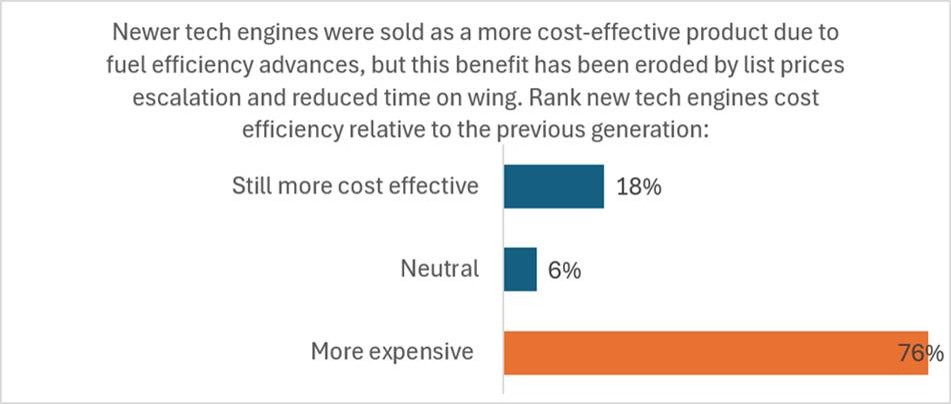
Source: Ishka Airfinance Aviation Finance Festival: Asia conference poll in Singapore, on 24th September 2026
Spares ratio increases
One other cost factor for airlines is the ratio of spare engines needed to ensure smooth operations. Historically, for previous-generation narrowbody engines, many airlines would keep an 8% spare ratio. Today that figure is around 20% for new-technology narrowbody engines, according to leasing sources. “It’s a big shift,” reflects one lessor.
“It’s a big drag on P&L when you think about how expensive some of these new engines are,” reflects another lessor speaking to IA Insights. A single new CFM LEAP-1A26 (a -1A model with a 26,000-pound thrust rating) is now roughly $23 million while a new GTF PW1127 (the thrust variant used for the Airbus A320neo family) is aproximately $22 million, according to Ishka Airfinance appraised values.
The mystery of the true cost of repairs
Lessors state that one of the issues when trying to understand the economics of operating new-generation engines is that there is a lack of overhaul data for LEAPs and GTFs. The bulk of new-generation engines are under some form of OEM-controlled flight-hour agreement, which obscures the true cost of maintenance, or else are undergoing work at an OEM-controlled facility. In addition, the vast majority of new-techology narrowbody engines are less than 10 years old, with only a fraction of the engines having undergone a full performance restoration.
Lessors share that engine investors are still effectively second-guessing some of the key operational metrics, including Mean Time Between Removals (MTBRs), an essential reliability metric to determine the true cost of repairs.
“There is a lack of accurate data”, explains one senior lessor, who argues that most engine owners are likely to be under-reserved. “So as an investor, you're actually really underwriting the credit, and you're hoping that the airline's still around in five years or 10 years when that lease is up… I think the OEMs and the engine MROs who are maintaining those engines or doing the MRO work don’t really understand the economics of those engines yet, and so that’s really affecting how investors look at the engines. You can use the OEM guidance, but that's been historically a little low, right? So, until there's more data out there. It's a guessing game.”
Insights research a year ago suggested that the true cost for an latest-generation narrowbody engine shop visit was roughly between $13.6 and $14.7 million, including LLPs for a GTF or a LEAP engine (see Insights research: ‘How rising engine LLP prices are increasing MRO costs.’)
Things are improving: It is worth noting that LEAP MRO capacity has effectively doubled over the past two years while engine-related aircraft groundings across the LEAP fleet have fallen to near zero.
In addition, CFM announced on 18 July 2026 that its LEAP-1B high-pressure turbine (HPT) durability kit had received FAA and EASA certification. CFM expects the upgrade to double time on wing in hot and harsh operating environments, including the Middle East and India, with full production cutover planned for early 2027.
There has also been relatively quick adoption of these upgrades. CFM reports that more than 40% of the LEAP-1A fleet now operates with the high-pressure turbine (HPT) durability kit and more than 70% of the fleet also operates with the reverse bleed system (RBS), which is designed to reduce on-wing fuel-nozzle replacement requirements.
Speaking with Insights a CFM spokesperson stated: “CFM is focused on delivering for customers. We’ve made significant investments to enhance time on wing, reduce cost of ownership, and increase output, and we will continue to invest to drive meaningful improvements. While there is more to do, we are making progress every day to continue to deliver long-term value for our customers.”
Pratt & Whitney were not available for comment as Insights went to press.
The IA View
The OEMs have done a successful job of marketing new engines to airlines and lessors and highlighting the promised 15% or greater in fuel burn savings.
However, many airlines are dealing with the unexpected maintenance burden associated with operating narrowbody engines that can only deliver a third of the cycles promised by legacy powerplants. These costs range from labour for removing engines, to the time lost in waiting for, and undergoing, maintenance work, as well as the increased spares provisioning.
All of this, several lessors and airlines believe, has heavily eroded the fuel savings touted by the OEMs, compared to the CFM-5Bs, -7Bs, and V2500s that they are replacing.
It is important to stress that there is a lack of data when it comes to the true cost of maintenance for the LEAP and GTF engines because the engines are still relatively young, and the scope and cost of the maintenance that has been undertaken has all been controlled by the OEMs. This obscures the final cost for the airlines, many of which, but not all, pay a monthly maintenance servicing agreement to the OEM to cover repairs and part costs.
Nevertheless, airlines can still forecast some of these numbers by looking at the cost of leasing or owning enough spare engines, the operational costs of having to take off and move engines for repairs, as well as the monthly fixed maintenance costs the OEMs are charging. It is this experience which has caused several airlines to complain to lessors that the maintenance burden for new-technology narrowbody engines is, they believe, outweighing the promised fuel savings.
High engine spares ratios are still needed due to the lengthy MRO turnaround times. OEMs, and their MRO partners, have invested heavily in additional MRO facilities over the past 24 months, but the sheer backlog and, crucially, the need to often wait for key components to be manufactured means MRO turnaround times are still elongated.
It is also important to stress that the ongoing maintenance costs, referenced by lessors and airlines are completely separate from the revenue impact caused by the GTF powdered metal issues, which forced hundreds of A320neo family aircraft to be grounded to allow inspections. Looking forward, rising fuel prices will help the economics of owning and operating a LEAP and GTF engine. In addition, lessors believe that the OEMs will continue to make improvements on time-on-wing with future iterations, particularly the enhanced durability promised with the GTF Advantage version, and other recent upgrades to the LEAP.



Sign in to post a comment. If you don't have an account register here.