
EU Taxonomy reporting by airlines in 2025 shows on average a 2.1 percentage point increase in alignment across their economic activities, increasing from 6.2% in 2024 across all metrics to 8.3% in 2025, according to a sample of 15 airlines analysed by Ishka Airfinance. Average Taxonomy eligibility increased from 36.9% in 2024 to 42.5% in 2025, a 5.6 percentage point increase.
This is Ishka Airfinance SAVi’s second analysis of aviation EU Taxonomy disclosures following last year’s first set of disclosures. As large corporates in the EU, many airlines have an obligations to measure their operational expenditures, capital expenditures and turnover against the EU Taxonomy’s aviation technical screening criteria (TSC).
Last year’s disclosures revealed wide disparities in reported eligibility and alignment across airlines due to, in large part, significant differences in how companies interpreted the criteria. A year later, alignment is more visible across the 15-airline sample, though this second reporting cycle has not necessarily simplified airline-to-airline comparisons, due to changes to the Taxonomy rules, continuing areas of company judgement, and differences in accounting methodology.
New in 2026
The 10% materiality threshold
At the start of this year, a European Commission Delegated Regulation (2026/73) introduced several changes that have shaped this year’s airline EU Taxonomy reporting. The regulation, a component of last year’s Omnibus I package to cut red tape (the same that narrowed the scope of CSRD), introduced a 10% materiality threshold, allowing companies to leave some activities unassessed where their cumulative contribution falls below 10% of the relevant turnover, CapEx or material OpEx denominator.
Application of this new threshold was uneven across the airline sample. Aegean, Air France-KLM, Finnair, IAG, Lufthansa and TAP applied the new 2026/73 framework in their 2025 disclosures, while TUI explicitly did not. airBaltic also appears to have retained its previous methodology, while Norse Atlantic Airways, Norwegian and Icelandair do not explicitly state whether they adopted it. As for Ryanair, its FY25 began before 2025 and therefore falls outside the transitional choice.
Putting out the ‘fire extinguisher’
Additionally, a revision to the DNSH criteria on chemicals, added an exemption for certain substances used in aircraft fire extinguishers and fire-protection systems. Chemical-use requirements had last year prevented or complicated Taxonomy alignment for several airlines.
In 2024, Lufthansa concluded that requirements concerning certain chemicals under the generic pollution DNSH criteria made aviation alignment practically impossible. Its statutory Taxonomy tables therefore recorded no alignment, although it separately disclosed figures showing “potential” alignment under an alternative interpretation. For 2025, however, Lufthansa applies the simplified DNSH rules introduced under Delegated Regulation 2026/73 and now reports aviation alignment in its main Taxonomy tables.
However, and despite the new exemption, interpretive issues remains around the DNSH criteria – which led Wizz Air to opt out of reporting. IAG continues to state that uncertainty exists over the treatment of some safety-critical materials and says it has exercised judgement in concluding that the criteria are met. The group notes that, had it reached the opposite conclusion, it would have reported no alignment for any of its KPIs in either 2024 or 2025.
Scope of the analysis
Ishka Airfinance SAVi has reviewed 2025 or FY2025 disclosures of the same 15 airline groups analysed last year: Aegean, airBaltic, Air France-KLM, easyJet, Finnair, IAG, Icelandair, Lufthansa, Norse Atlantic Airways, Norwegian, Ryanair, SAS, TAP Air Portugal, TUI and Wizz Air.
Twelve provide some form of EU Taxonomy disclosure, compared with 11 in last year’s analysis.
- For the first time, TAP Air Portugal is included in the charts, after publishing Taxonomy information for 2025 and subsequently issuing a supplementary technical note clarifying its KPI figures.
- easyJet does not provide an EU Taxonomy disclosure in its FY2025 annual report. As noted in last year’s report, while the airline has substantial operations throughout the EU it is headquartered in the UK.
- SAS continues not to report following its delisting and transition to private ownership.
- Wizz Air once more opted not to include a disclosure, citing continuing regulatory uncertainty, particularly around the application of the DNSH criteria.
As was the case last year, and with the exception of Norse Atlantic Airways, the external auditors for the analysed airlines are all Big Four accounting firms.
Compared with the first year of aviation alignment reporting, non-zero alignment is considerably more widespread in the 2025 disclosures.
Joining the airlines that reported some alignment in last year's disclosures (airBaltic, Air France-KLM and IAG) are now Finnair and Lufthansa (numbers included in last year's update were Lufthansa's 'potential' estimates as the company did not officially report alignment). Air France-KLM's total aligned share increased from 23.0% to 27.3% of total turnover, from 48.6% to 59.5% of total CapEx, and from 18.5% to 24.9% of total OpEx. IAG's total aligned turnover increased from 34.9% to 41.8% and total OpEx from 57.1% to 65.8%, although total aligned CapEx declined from 64.7% to 60.0%. Finnair, meanwhile, moved from zero alignment across all three KPIs in 2024 to 23.3% of total turnover, 1.8% of total CapEx and 27.2% of total OpEx in 2025. These movements should not, however, be interpreted entirely as changes in underlying environmental performance, particularly given the regulatory and methodological changes outlined above.
3.21 Manufacturing of aircraft
In most cases, revenue in this category typically includes MRO services provided to other airlines, with CapEx covering investments in maintenance infrastructure, and OpEx covering maintenance and repair costs. As a result, airline groups with in-house MRO business feature more prominently.
Note: These charts and others below should be viewed as an illustration of reporting practices rather than a direct ranking of airline environmental performance. Changes in reported eligibility or alignment may reflect regulatory and methodological changes as well as changes in an airline’s operations.
* Note: Lufthansa’s 2024 figures are the airline’s separately disclosed ‘potential’ alignment estimates. Its statutory 2024 Taxonomy tables reported no alignment
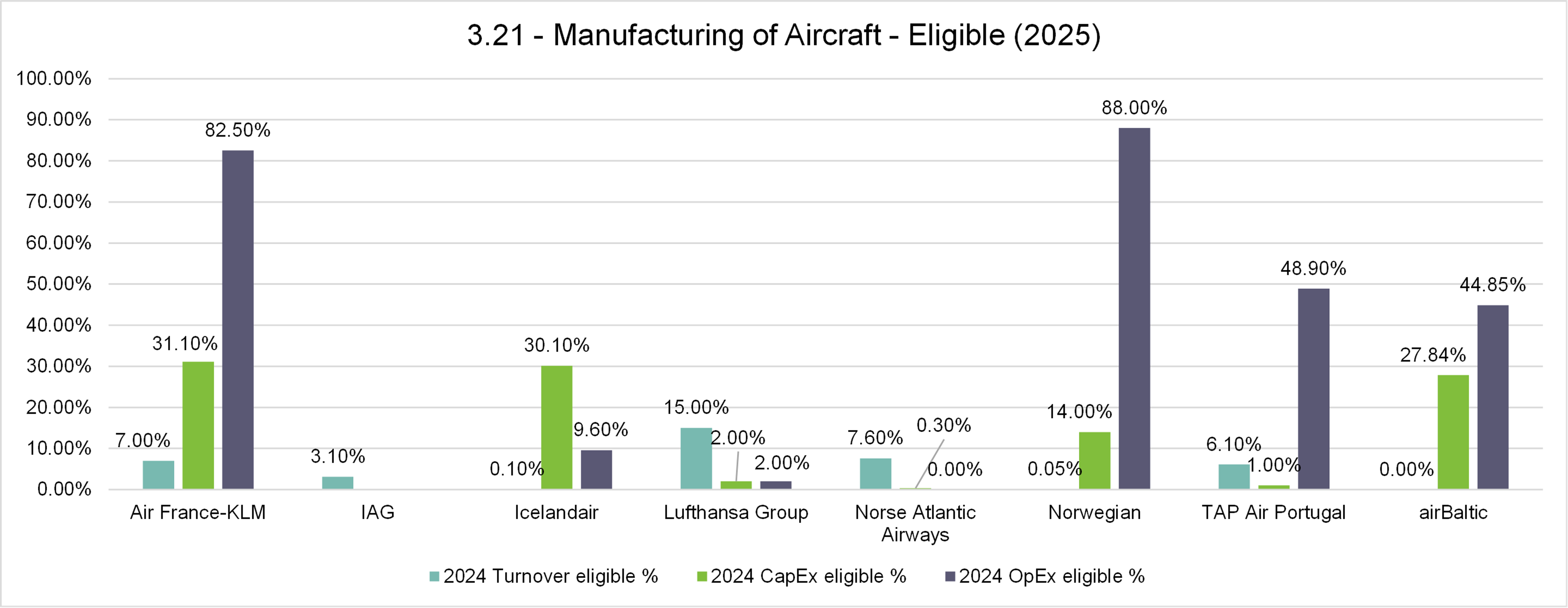
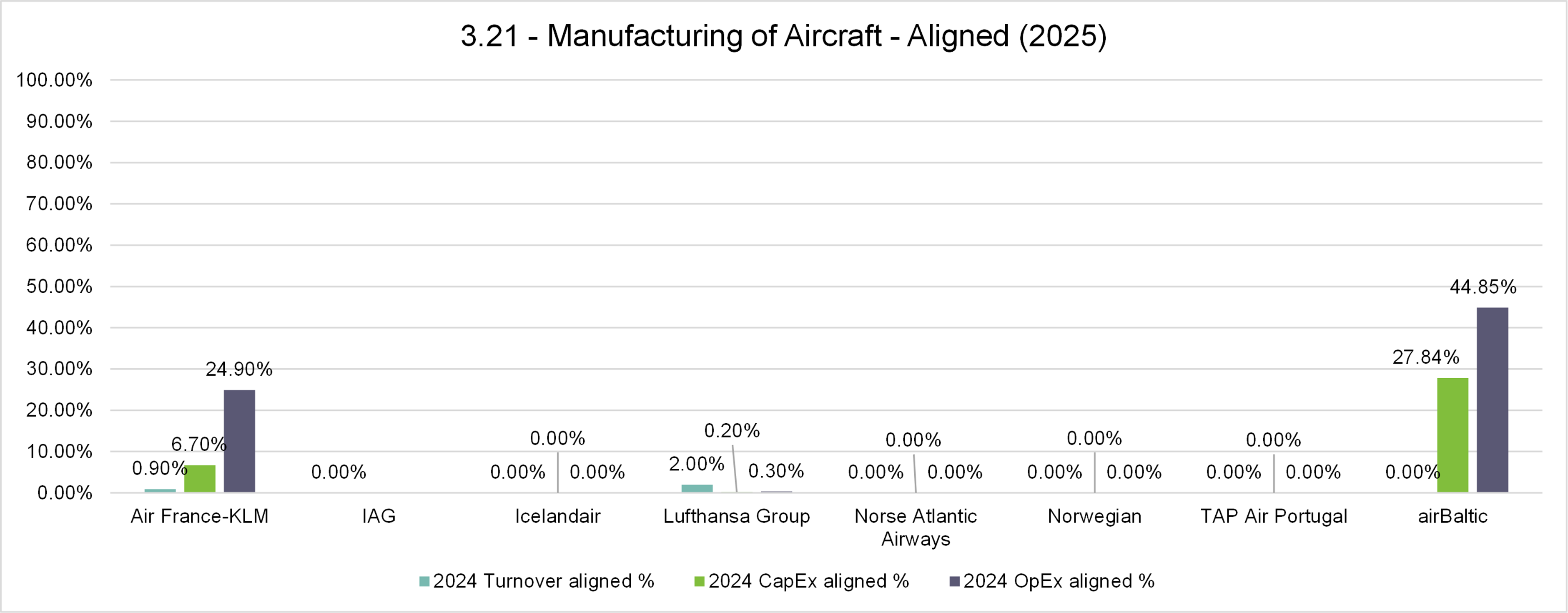
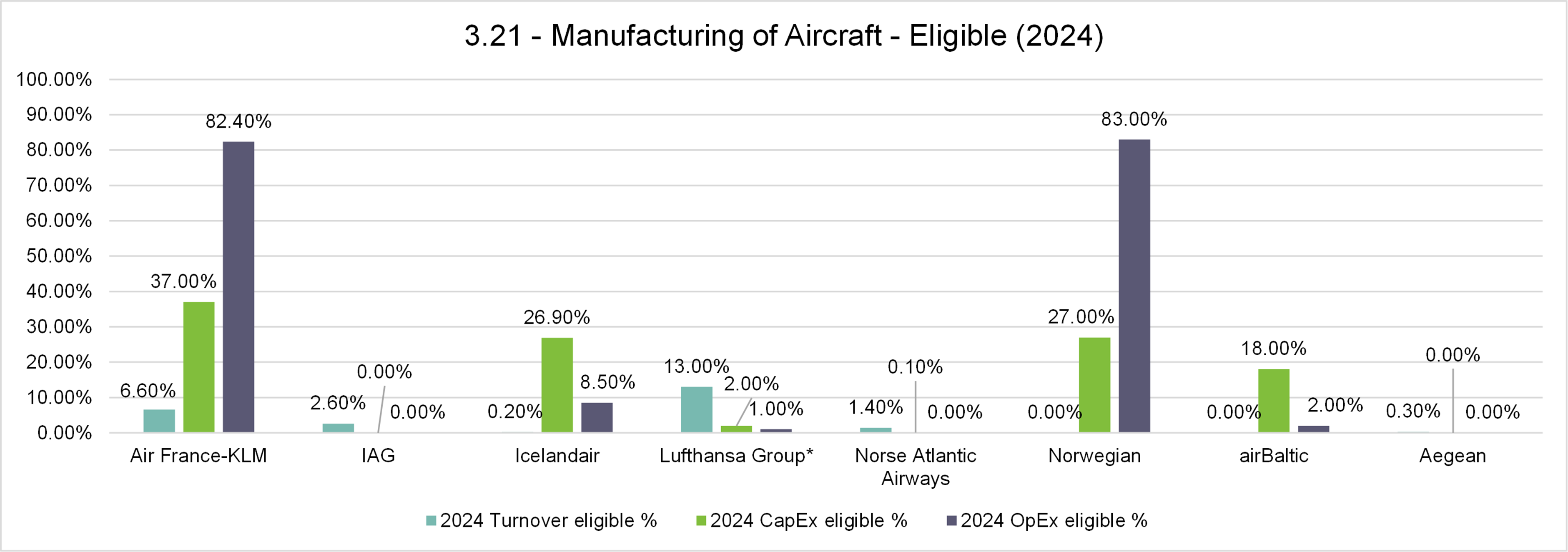
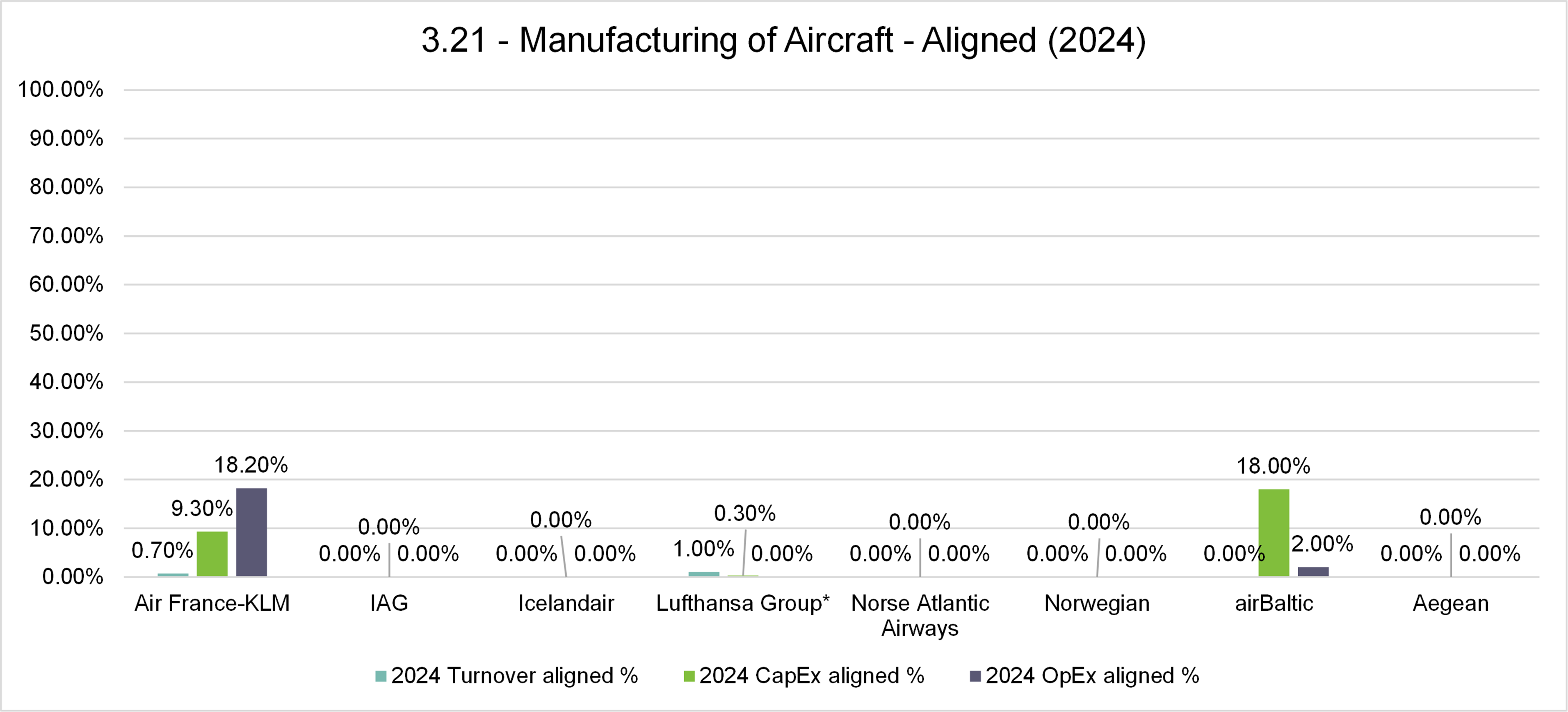
Three airlines report some alignment under 3.21 in 2025: Air France-KLM, Lufthansa and airBaltic. Air France-KLM reports 7.0% of turnover, 31.1% of CapEx and 82.5% of OpEx as eligible under the activity, while 0.9%, 6.7 % and 24.9%, respectively, are aligned – numbers broadly in keeping with last year’s disclosure. airBaltic presents a different profile, reporting no turnover under 3.21, but 27.84% of total CapEx and 44.85% of total OpEx are both eligible and aligned. This represents a substantial increase from 2024, when 18% of total CapEx and just 2% of OpEx were aligned under 3.21. The carrier attributes the increase in aligned OpEx primarily to higher maintenance and engine-overhaul costs on its Airbus A220-300 fleet.
Lufthansa also moves from no identified alignment under the activity in 2024 to alignment in 2025, including 2% of total turnover and smaller shares of CapEx and OpEx, following its adoption of the revised DNSH criteria (see details earlier in this report).
6.19 Passenger and freight air transport
Eligibility remains very high for most airline groups under 6.19. This is the core area of activity of the analysed airlines and therefore all with EU Taxonomy disclosures are represented. In most cases, turnover covers total passenger revenue across airfare and ancillary, cargo revenue, and, in some cases, charter revenue. CapEx includes activities like spending on aircraft and reserve engines, rights-of-use to aircraft and reserve engines. OpEx comprises direct expenses incurred to ensure the operational readiness of aircraft and engines.
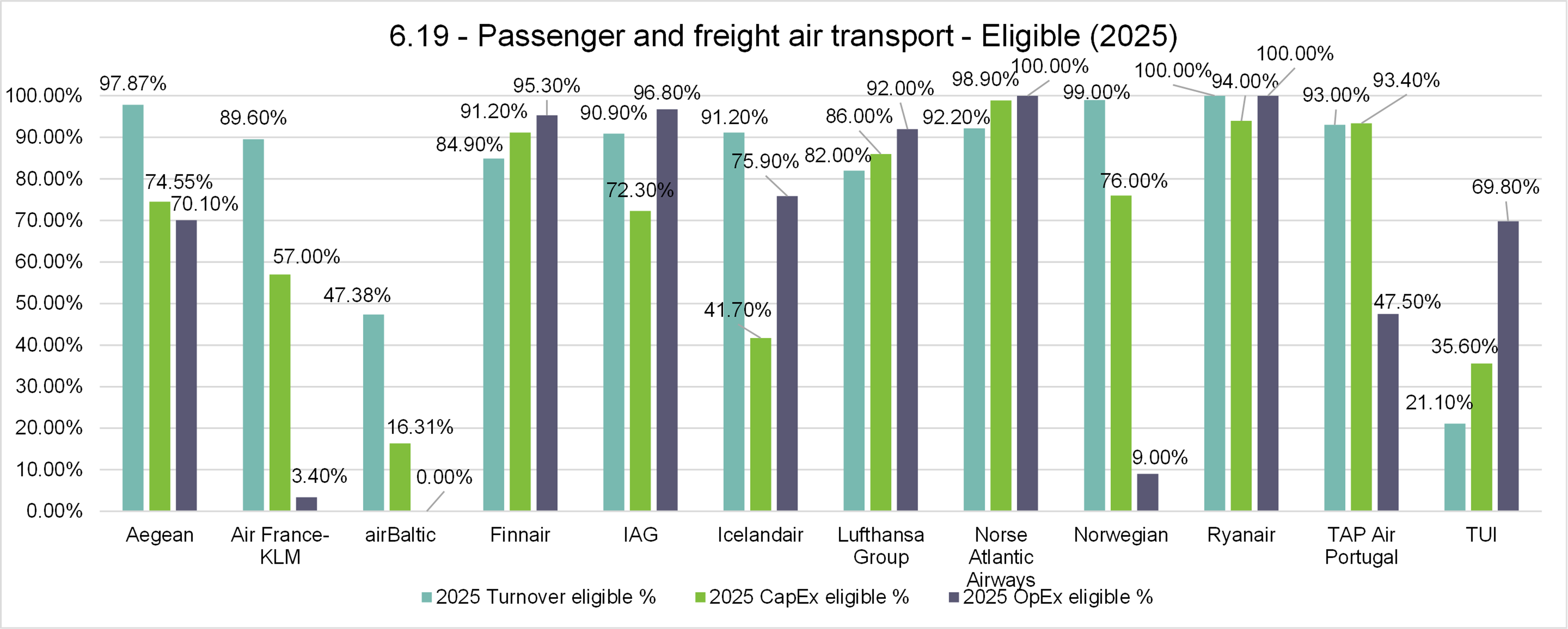
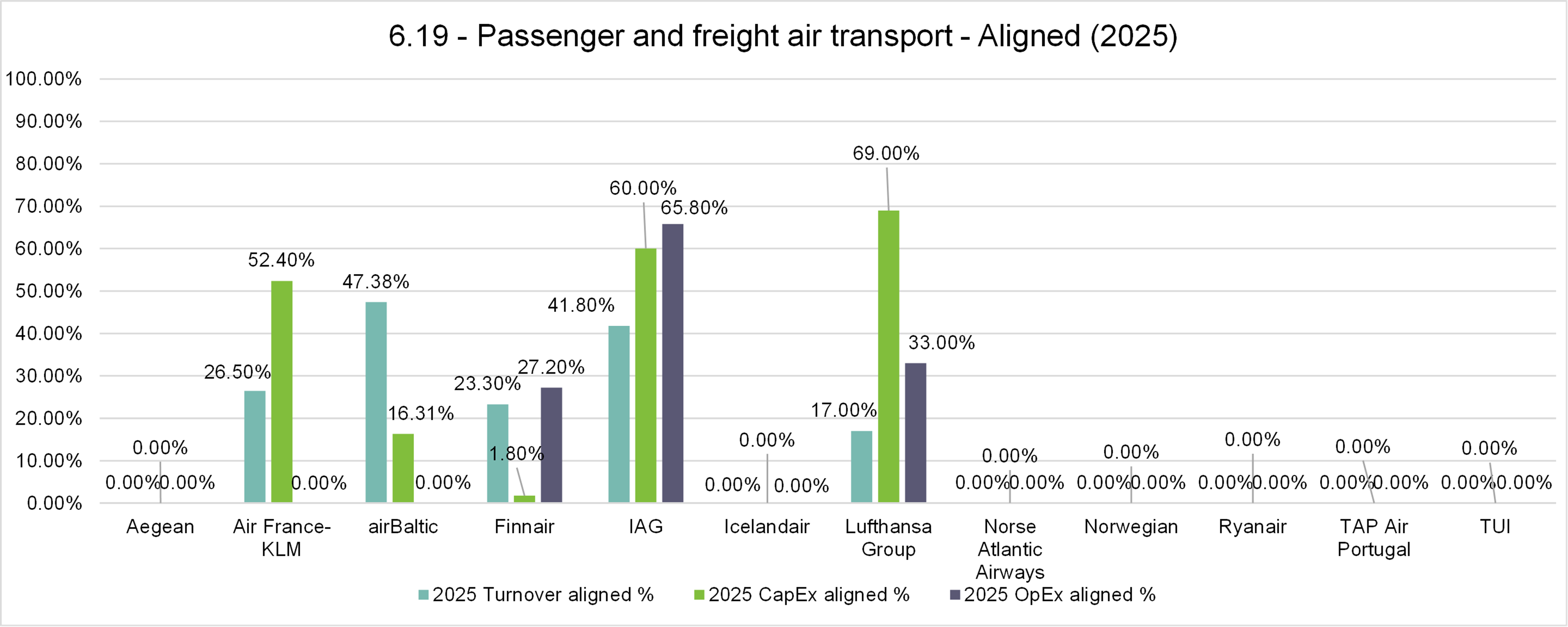
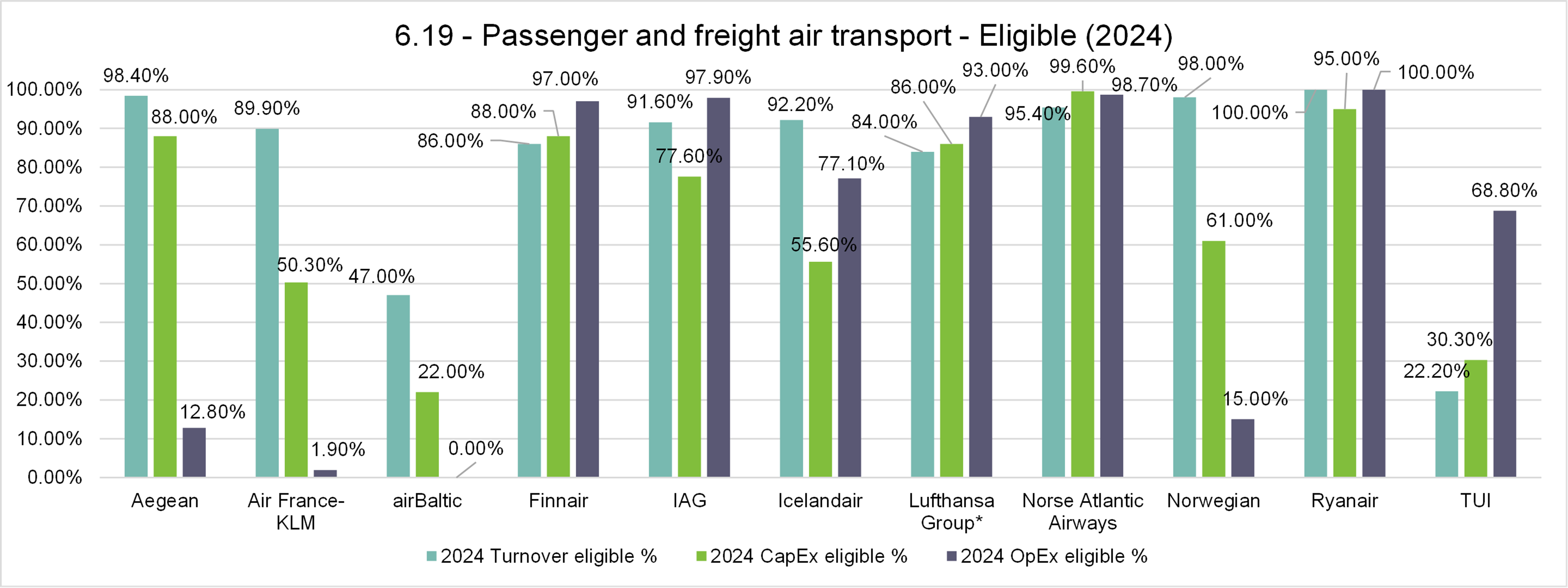
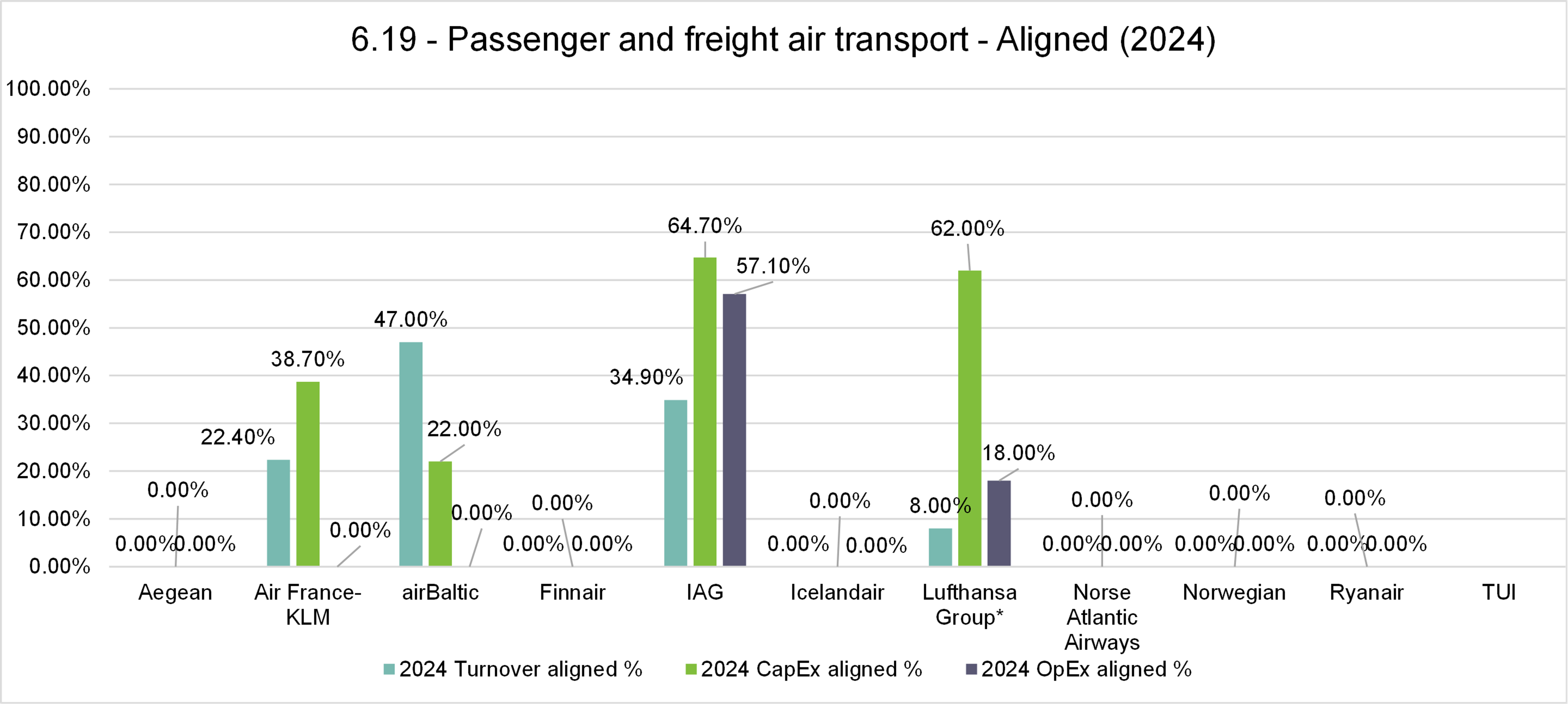
Note: TUI did not assess alignment in 2024.
*Lufthansa’s 2024 figures are the airline’s separately disclosed ‘potential’ alignment estimates. Its statutory 2024 Taxonomy tables reported no alignment. TUI did not assess alignment in 2024.
Year-on-year, IAG's aligned 6.19 turnover increased from 34.9% in 2024 to 41.8% in 2025, while aligned OpEx rose from 57.1% to 65.8%; aligned CapEx moved in the opposite direction, from 64.7% to 60.0%. airBaltic's aligned 6.19 turnover was broadly unchanged at around 47%, while its aligned CapEx declined from 22% to 16.31%. Finnair and Lufthansa (see note above), by contrast, moved from no official reported alignment in 2024 to material alignment in 2025.
There are some reported methodological complications within the air transport criteria worth highlighting. SAF provides one route through which an otherwise non-compliant aircraft can meet the substantial-contribution test. For 2025, the relevant threshold is 11% SAF use, but the assessment does not require the fuel to have been physically consumed by the aircraft to which it is attributed. Instead, airlines can allocate fleet-level SAF purchases to a subset of aircraft for the purpose of the Taxonomy calculation.
IAG notes that the Taxonomy provides no detailed guidance on how that allocation should be undertaken and that it has therefore applied judgement, allocating SAF according to fuel consumption by aircraft family. It also argues that the global aircraft replacement ratio used in the turnover calculation is outside individual airlines’ control and does not improve comparability between carriers.
NGO Opportunity Green, which has supported an unsuccessful lawsuit against the EU Taxonomy’s aviation criteria, has also criticised the SAF methodology on the basis that it can concentrate limited SAF purchases on a selected portion of the fleet for Taxonomy purposes. They also highlight an unusual consequence of the OpEx rules, as SAF use can help make aircraft operating and maintenance expenditure aligned, while the expenditure on SAF itself is excluded from Taxonomy-eligible OpEx.
6.20 Air transport ground handling operations
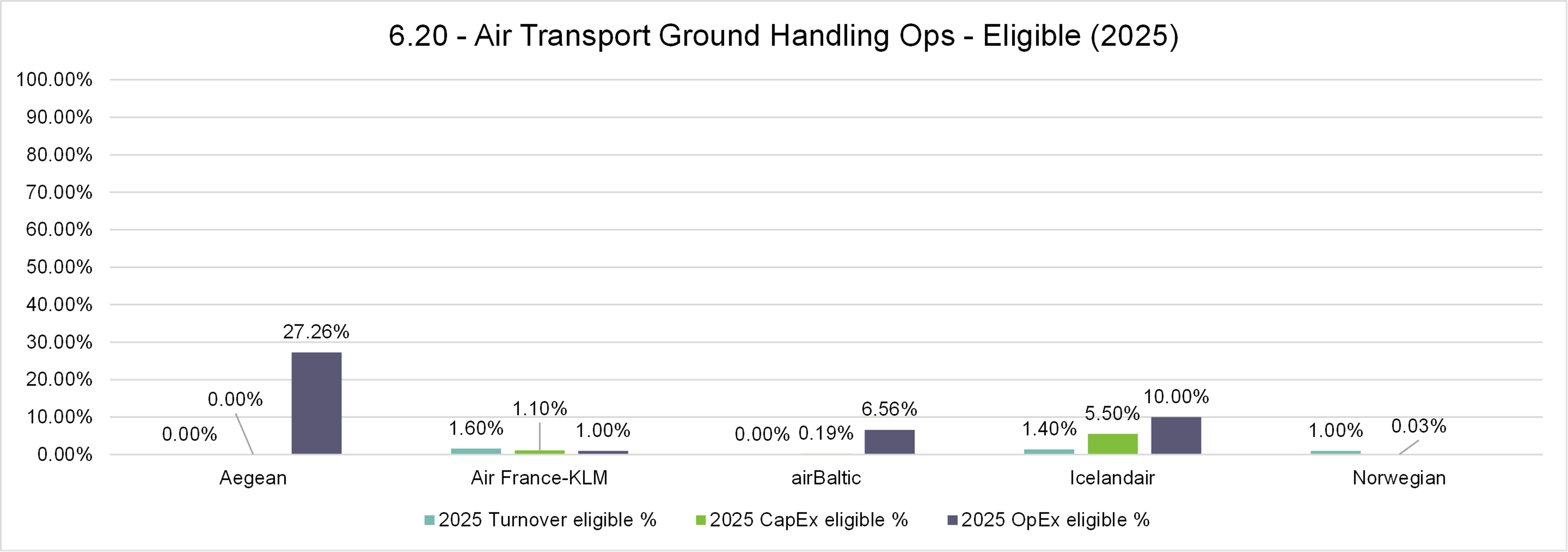
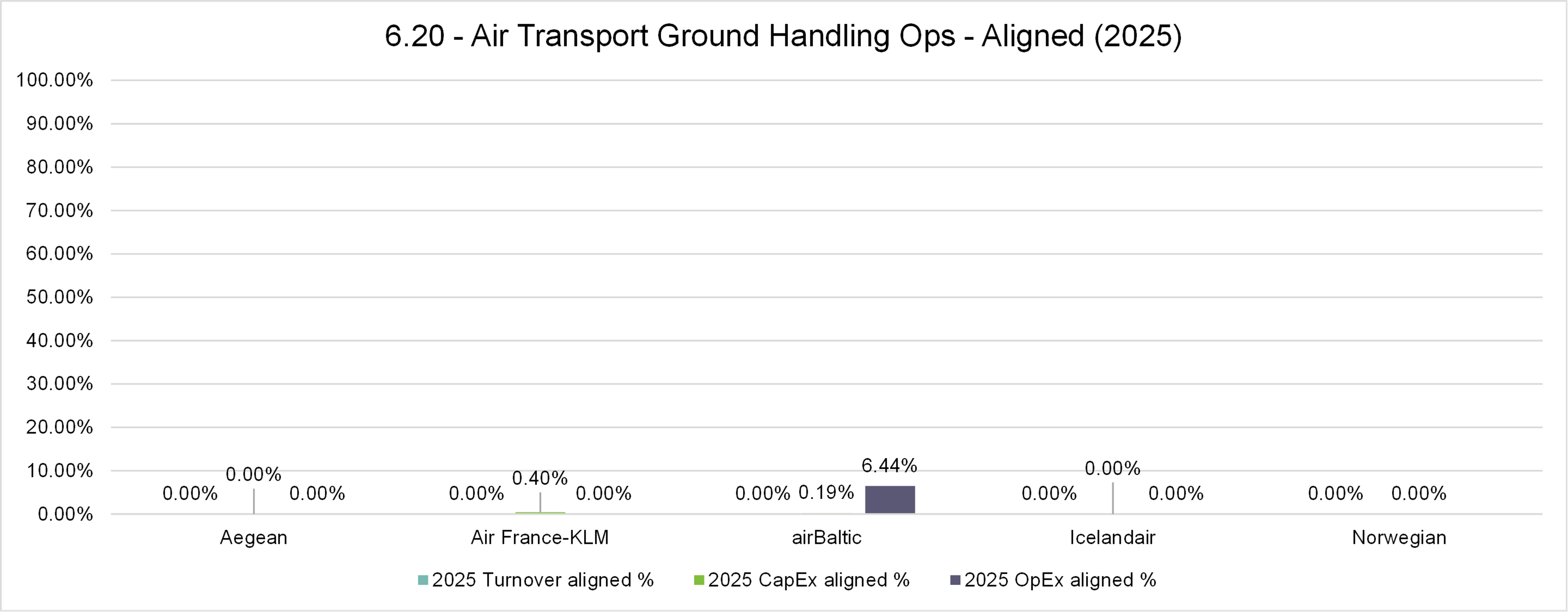
Ground handling remains a smaller and less consistently reported activity. Revenue in this category may include handling operations performed for other carriers. CapEx may include the leasing or purchase of ground vehicles to carry out handling activities. OpEx are not described, but is understood to cover costs associated with ground operations and handling leases. Aegean attributes 27.26% of its Taxonomy-eligible OpEx to 6.20 but reports no alignment, while Icelandair reports as eligible 1.4% of turnover, 5.5% of CapEx and 10.0% of OpEx, but again with no alignment. Air France-KLM reports alignment only in CapEx: 1.1% of total CapEx as eligible, and 0.4% is aligned.
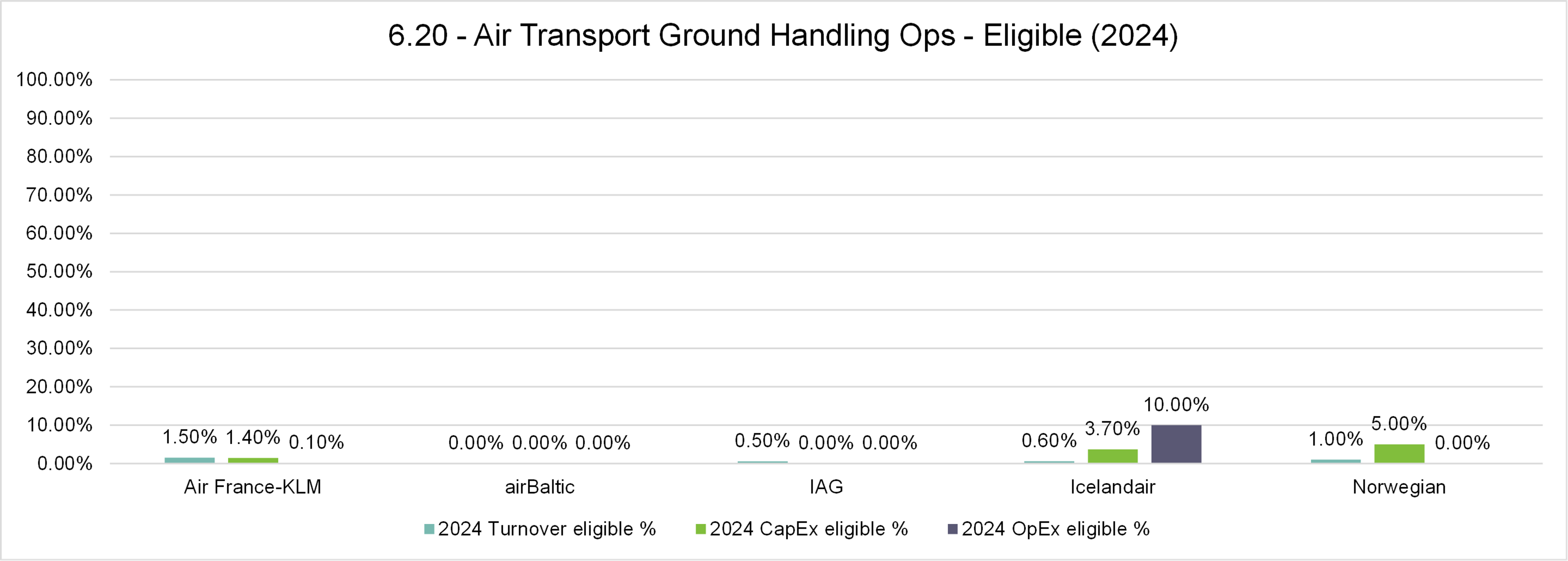
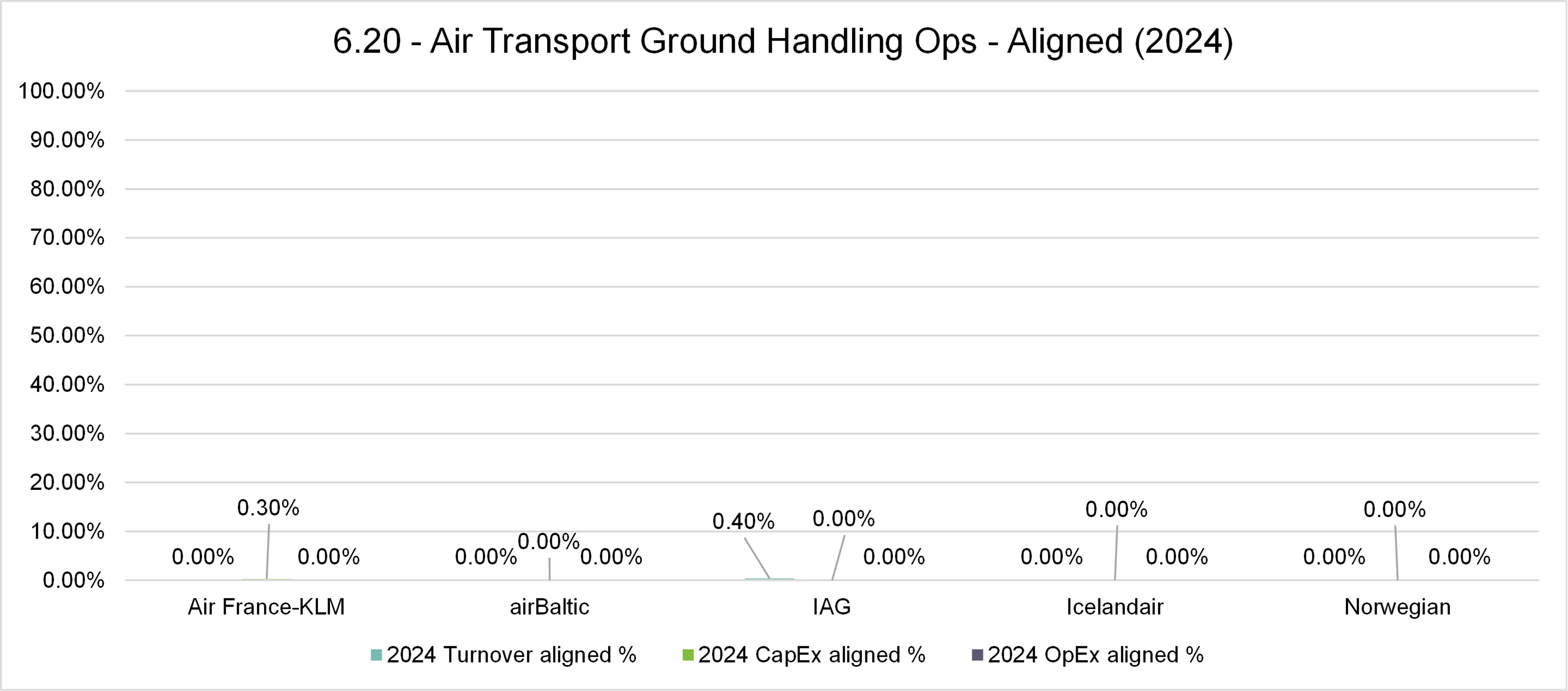
airBaltic records the highest degree of alignment within the activity: its 0.19% CapEx share as eligible and entirely aligned, while 6.56% of total OpEx is eligible with 6.44% aligned, or around 98%. Both were zero in the 2024 comparison. IAG illustrates a separate reporting issue created by the new materiality provisions. The group identifies ground handling among its relevant activity, but does not assess it for eligibility or alignment in 2025, instead reporting amounts equivalent to 0.6% of turnover and 8.4% of CapEx as non-assessed and immaterial.
Ground handling provides a useful contrast with the transitional aircraft criteria, as eligibility may cover vehicles and equipment used in ground operations. Consequently, alignment can arise from electric or other zero-emission equipment. Unsurprisingly, NGO Opportunity Green identified electric ground-handling equipment as the main source of the comparatively small amount of airline CapEx it classified as “genuinely sustainable” rather than transitional.
At the same time, the new materiality rules may make small activities such as ground handling less visible in future disclosures. IAG, for example, identifies 6.20 among its eligible activities but treats it as non-material in its 2025 assessment.
Non-aviation activities
In addition to EU Taxonomy alignment across the aviation criteria, many of the analysed airlines also reported eligibility and alignment across other sectors and activities that, in most cases, are not core to their business.
Non-aviation activity remains particularly sensitive to differences in group structure. For TUI, hotels, cruises and other tourism activities form a significant part of its economic activity, while most other airlines in the sample remain overwhelmingly focused on air transport.
The introduction of materiality thresholds adds another complication, as airlines applying the simplified regime can omit assessment of smaller activities that previously appeared separately in Taxonomy disclosures, reducing the usefulness of year-on-year comparisons in some non-core categories.
The Ishka Airfinance View
This second year of aviation EU Taxonomy disclosures has produced a more substantial share of aligned capital than the first. The central objective of the EU Taxonomy is to become a guiding framework for investors to identify companies whose operations favour economically sustainable activities. Enabling comparability is at the heart of that mission, and though this overview does not fully explain the differences in alignment across airlines, the level of methodological disclosure has improved markedly since last year.
Most airlines reviewed now provide at least some explanation of the criteria or judgements determining alignment, and several give detailed accounts of issues such as aircraft eligibility, the replacement ratio, SAF allocation, and DNSH requirements. The level of detail nevertheless remains uneven, and disclosures do not always make it possible to determine whether differences between airlines reflect underlying operations or different interpretations of the criteria.
Ongoing work to refine the criteria should deliver better comparability in future disclosures. Following the EU General Court ruling at the end of September, a lawsuit that added to the legal and regulatory scrutiny surrounding the framework, airlines at least now have more clarity on the legal standing of the criteria going forward. As part of the legal challenge, brought by a group of environmental NGOs, the plaintiffs had argued that allowing conventional fossil-fuel aircraft to qualify as transitional activities is inconsistent with the Taxonomy’s purpose and requirements, and are considering an appeal.