
Five noteworthy aviation sustainability developments in the past seven days curated by the Ishka Airfinance SAVi team.
Here are the new developments to keep in mind:
1. IATA: SAF Scope 3 certificates could grow x6 by 2030, but cover only 5%-10% of all SAF
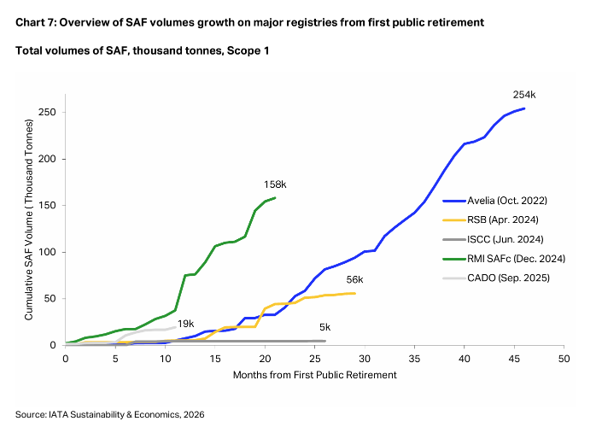
SAF Scope 3: SAF environmental attribute certificates (EAc), also known as Scope 3 certificates, traded under a book-and-claim could expand three- to six-fold by 2030, to somewhere between about 1.0 Mt and 1.9 Mt of SAF, a new IATA report supported by Airbus and Accenture reveals. The report, unveiled on 14th October, estimates that these certificates, typically bought by corporates but also freight shippers and forwarders (as resellers), have an abatement cost ($/tCO2e) of $150 to $500 depending on the type of SAF – or $474 to $1,580 per tonne of SAF. Airlines, it says, hold a natural and important channel selling them, but not a captive one, accounting for around 53% of corporate SAF EAc sales, ahead of SAF producers and suppliers at roughly 18%, and buyers’ alliances at 11%. Independent registry activity remains small and concentrated, with over 200 thousand tonnes of SAF retired for airline customers cumulatively between 2022 and 2026. Two platforms (RMI SAFc and Avelia) account for around 80% of this volume (see chart on Page 18, also included below).
According to analysis underlying the study, voluntary demand for EAcs stood at roughly 323,000 tonnes in 2024, about 30% of that year’s SAF supply. Therefore, while the market will expand, SAF supply will outpace that growth and result in absolute volume of voluntary demand of only about 5% to 10% of global SAF supply by 2030. “The voluntary market would therefore grow quickly but remain a minority share of a much larger physical market.” The report also breaks down (see page 14) the potential for SAF cost sharing across corporates, environmental surcharges on passenger tickets, voluntary passenger contributions, and potential rebates and incentives such as US-style tax credits. The breakdown – any airline’s dream – leave only a very small portion of unrecovered SAF premium costs.
Source: The SAF Environmental Attribute Certificate Market (IATA, Airbus, Accenture)
The report was unveiled during the IATA World Sustainability Symposium held this week. At the event, hosted in Brussels, IATA also reiterated its view that carbon pricing for aviation should only exist under CORSIA, a veiled and recurring criticism of the EU ETS. “Overlapping carbon schemes will only raise the cost of flying without lowering emissions,” noted in her speech Sandrine Le Borgne, IATA’s Interim Director General (Saadia Zahidi, IATA’s next director general, will assume the role on 1st November). Marie Owens Thomsen, IATA’s SVP Sustainability & Chief Economist, also reiterated the view that fossil energy, and not the industries that rely on it, should be the target of policy actions.
Ahead of the event, IATA also announced that ICAO has joined its Supporting Alliance for CORSIA EEU Supply. The Alliance brings together more than 80 CORSIA stakeholders to address EEU bottlenecks. Also this week, IATA and trading venue Xpansiv announced plans for a new CORSIA Phase I EEU procurement event next month, which follows similar ones last October and November 2024.
The Ishka Airfinance View: In recent years, several reports have explored the potential of SAF Book and Claim to generate additional revenue and help narrow the cost gap between SAF and conventional jet fuel. IATA’s latest report adds a crucial missing piece: an estimate of future demand relative to SAF supply. While speculative, its projection that SAF certificates could account for 5% to 10% of SAF supply by 2030 provides a meaningful benchmark for the contribution Book and Claim could make towards closing SAF’s cost premium.
2. EU court ruling could strengthen enforcement of environmental limits on airport growth
Airports: The Court of Justice of the European Union (CJEU) on 15th October ruled that legally binding airport passenger caps must be respected in slot allocation decisions, even if this results in airlines losing historic slot rights. The judgment could have wider implications for European airports subject to restrictions aimed at managing aviation's environmental impacts, including noise pollution and emissions associated with traffic growth.
The judgment followed a December 2024 referral from Ireland's High Court, arising from legal challenges launched earlier that year over the application of Dublin Airport's 32-million-passenger cap to seasonal slot allocation – the cap was set in 2007/2008. The Irish Aviation Authority (IAA) had sought to reflect this limit in seasonal slot allocation parameters, prompting legal challenges by airport operator daa, airlines Aer Lingus, Ryanair, Delta Air Lines, JetBlue Airways, United Airlines and Emerald Airlines, as well as from US airline trade association Airlines for America (A4A).
The CJEU found that airport capacity assessments must account for legally binding restrictions and further clarified that historic slot rights do not guarantee reallocation where capacity is restricted. Airlines could therefore lose previously held slots, which the Court determined do not constitute protected property rights. The ruling does not impose the slot reductions at Dublin, for which implementation remains suspended under an Irish High Court order, pending domestic proceedings.
The dispute comes amid concerns over the climate consequences of removing restrictions on airport growth. A September 2026 report by NGO Transport & Environment (T&E) estimated that planned expansion at 20 European airports would exceed their modelled Paris-aligned carbon budgets, consistent with limiting warming to 1.7°C, even accounting for projected aircraft efficiency improvements and SAF uptake. For Dublin, the analysis estimated that its modelled remaining budget of approximately 27 million tonnes of CO2 could be exhausted by 2034, with annual aircraft emissions potentially rising 65% under expansion. Irish airport operator daa disputed the findings, arguing that the airport-specific carbon budgets are not legally established targets and that aircraft emissions are regulated through the EU ETS and CORSIA.
3. COP31: EU outlines priorities as sustainable aviation initiatives prepare for Antalya
COP31: The Council of the European Union on 12th October adopted its negotiating position ahead of the 31st UN Climate Change Conference (COP31), scheduled for 9th to 20th November in Antalya, Türkiye. The EU will prioritise implementation of existing climate commitments, accelerating the transition away from fossil fuels and mobilising additional climate finance, while separate initiatives targeting aviation emissions and taxation are expected to feature in discussions surrounding the summit.
The conclusions acknowledged that global warming is likely to exceed 1.5°C in the coming decades, calling for accelerated emissions reductions to minimise the extent and duration of any overshoot. It urged countries to implement their nationally determined contributions (NDCs) and called for COP31 to strengthen the UNFCCC's Mitigation Work Programme, alongside advancing the transition away from fossil fuels, tripling renewable energy capacity and doubling energy efficiency improvements. The EU also wants the summit to establish the direction for the second Global Stocktake, which will assess collective progress towards the Paris Agreement's objectives. On climate finance, separate conclusions adopted on 9th October reaffirmed the goal of mobilising at least $300 billion annually for developing countries by 2035, alongside broader efforts to scale finance from public and private sources to $1.3 trillion annually. The document called for greater use of innovative financing instruments, including carbon markets, green bonds and debt-for-climate swaps, and acknowledged the role of carbon pricing in phasing out fossil fuels. Neither set of conclusions explicitly addresses aviation.
The industry will nevertheless feature in several events alongside the COP31 negotiations. The International Civil Aviation Organization (ICAO) is hosting a side event on 9th November addressing aviation decarbonisation, cleaner energy and climate resilience, while Turkish Airlines and the Zero Waste Foundation have announced a Global Sustainable Aviation Forum for 10th November, covering SAF, operational efficiency and emissions reductions. Separately, IATA and the Federation of Indian Chambers of Commerce and Industry (FICCI) will host a session on 19th November examining the relationship between CORSIA, Article 6 of the Paris Agreement and countries' nationally determined contributions (NDCs), including how the international aviation offsetting scheme could support national climate objectives. An earlier event organised by Verra and Singapore on 16th November will address scaling high-integrity carbon-credit supply through Article 6 authorisations, including for CORSIA. See here for a list of events and exhibits occurring on the sidelines of the conference.
No new aviation levy commitments or COP31 announcements have been confirmed by the Global Solidarity Levies Task Force (GSLTF), which was a prominent feature of discussion at last year’s COP 30 (see further details here).
4. ACI Europe strategy calls for airports to prioritise Scope 3, sustainable finance
Airports: Europe’s largest airport association, Airports Council International Europe (ACI EUROPE), at the end of last week launched its updated 37-page Sustainability Strategy for Airports 2.0, a practical framework for airports to integrate sustainability across their operations. The priorities from 2026 to 2030 include “SAF, hydrogen, and electric aircraft infrastructure roll-out,” “unlocking green finance,” and “stronger Scope 3 engagement” including with airlines. Its recommendations form a recipe for actions European airports may elect to take in the coming years. Ishka Airfinance notes the following takeaways:
- Scope 3: Airports at the Level 2 ‘Embed’ maturity level are encouraged to action a Scope 3 inventory (indirect emissions, the largest of which are aircraft emissions), with airports at Level 3 ‘Advance’ encouraged to pursue Scope 3 engagement. The report also includes a case study on Zurich Airport, the first globally to link landing charges to engine emissions (1997). Level 3 Airports are encouraged to include “performance-based charges.”
- Green bonds and sustainability-linked loans: Sustainable debt instruments are said to potentially offer lower-cost capital for decarbonised airports, enabled by social and environmental performance. It recommends airports at the highest Level 4 ‘pioneer’ maturity level to issue sustainability-linked bonds with social KPIs.
- SAF: Airports at Level 3 are encouraged to prioritise “SAF facilitation” with Level 4 airports encouraging “SAF blending where possible/facilitation, if appropriate and/or fuel facilitation” – a recommendation also echoed at the recent PTE Asia event in Singapore.
- Climate adaptation: The report highlights the financial risk of unmitigated climate risk, including stranded asset exposure. It highlights rising insurance premiums for high-exposure locations and the need for airlines to plan for climate-related disruptions.
On a related development this week, the International Council on Clean Transportation (ICCT) published a study weighing the pros and cons of single engine taxiing (SET) practices are airports in California. It finds trade-offs between lower CO2 emissions and NOx/soot as engines run at higher temperatures.
5. EDF and Systemiq publish SAF investor due-diligence framework
SAF: Environmental NGO Environmental Defense Fund (EDF) and sustainability consultancy Systemiq on 13th October published a 40-page due diligence guide aimed at financial institutions assessing investments in SAF production projects and the credibility of airlines' SAF procurement and transition strategies. The framework distinguishes between three tests: regulatory eligibility, commercial bankability and environmental integrity. It then translates technology, feedstock, policy and sustainability risks across different SAF production pathways into evidence requirements, warning indicators and potential investor actions. Two illustrative case studies involving a pre-FID European methanol-to-jet project and an airline's 2030 SAF procurement strategy demonstrate how the framework can inform investment decisions and engagement priorities.

Ishka Airfinance is proud to be a partner of Aviation Carbon 2026. Registrations for Aviation Carbon 2026 are now open. Ishka Airfinance subscribers can use the code Ishka2026 for a discounted rate (airlines may use IshkaFree2026, which entitles them to two free passes).